Ebook Download The Brain: The Story of You, by David Eagleman
The Brain: The Story Of You, By David Eagleman When writing can change your life, when creating can enrich you by offering much cash, why don't you try it? Are you still really confused of where understanding? Do you still have no suggestion with exactly what you are going to create? Currently, you will certainly require reading The Brain: The Story Of You, By David Eagleman A great author is a great user at once. You could define just how you compose depending upon just what publications to check out. This The Brain: The Story Of You, By David Eagleman could assist you to fix the issue. It can be among the appropriate resources to develop your creating skill.
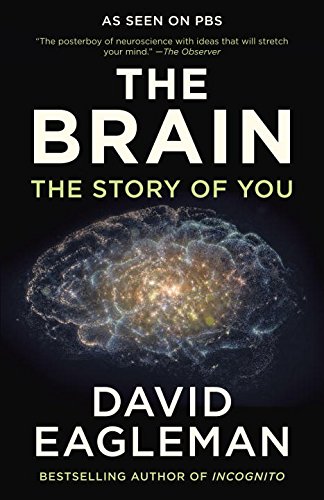
The Brain: The Story of You, by David Eagleman

Ebook Download The Brain: The Story of You, by David Eagleman
Do you think that reading is an important activity? Locate your reasons why adding is essential. Reading a book The Brain: The Story Of You, By David Eagleman is one part of pleasurable activities that will certainly make your life top quality a lot better. It is not regarding only just what kind of book The Brain: The Story Of You, By David Eagleman you read, it is not simply regarding just how numerous e-books you check out, it's regarding the practice. Reviewing habit will certainly be a method to make book The Brain: The Story Of You, By David Eagleman as her or his good friend. It will certainly no issue if they invest money and also spend more publications to complete reading, so does this e-book The Brain: The Story Of You, By David Eagleman
It is not secret when attaching the composing skills to reading. Checking out The Brain: The Story Of You, By David Eagleman will certainly make you obtain even more sources as well as sources. It is a way that can boost how you neglect as well as recognize the life. By reading this The Brain: The Story Of You, By David Eagleman, you can more than what you obtain from various other publication The Brain: The Story Of You, By David Eagleman This is a popular book that is published from renowned publisher. Seen kind the author, it can be trusted that this publication The Brain: The Story Of You, By David Eagleman will provide several inspirations, about the life as well as experience and everything inside.
You may not need to be question regarding this The Brain: The Story Of You, By David Eagleman It is not difficult means to get this book The Brain: The Story Of You, By David Eagleman You could just visit the distinguished with the link that we provide. Below, you could buy the book The Brain: The Story Of You, By David Eagleman by on the internet. By downloading and install The Brain: The Story Of You, By David Eagleman, you could find the soft data of this publication. This is the local time for you to start reading. Also this is not printed book The Brain: The Story Of You, By David Eagleman; it will exactly offer more perks. Why? You might not bring the published publication The Brain: The Story Of You, By David Eagleman or stack guide in your home or the office.
You can finely include the soft data The Brain: The Story Of You, By David Eagleman to the device or every computer hardware in your office or house. It will aid you to constantly continue reviewing The Brain: The Story Of You, By David Eagleman each time you have extra time. This is why, reading this The Brain: The Story Of You, By David Eagleman does not offer you problems. It will provide you vital resources for you who want to start writing, covering the comparable publication The Brain: The Story Of You, By David Eagleman are different publication area.
Locked in the silence and darkness of your skull, your brain fashions the rich narratives of your reality and your identity. Join renowned neuroscientist David Eagleman for a journey into the questions at the mysterious heart of our existence. What is reality? Who are “you”? How do you make decisions? Why does your brain need other people? How is technology poised to change what it means to be human? In the course of his investigations, Eagleman guides us through the world of extreme sports, criminal justice, facial expressions, genocide, brain surgery, gut feelings, robotics, and the search for immortality. Strap in for a whistle-stop tour into the inner cosmos. In the infinitely dense tangle of billions of brain cells and their trillions of connections, something emerges that you might not have expected to see in there: you.
This is the story of how your life shapes your brain, and how your brain shapes your life.
(A companion to the six-part PBS series. Color illustrations throughout.)
- Sales Rank: #2726 in Books
- Brand: VINTAGE
- Published on: 2017-03-07
- Released on: 2017-03-07
- Original language: English
- Number of items: 1
- Dimensions: 8.00" h x .80" w x 5.20" l,
- Binding: Paperback
- 256 pages
Features
Review
Nature
"An ideal introduction to how biology generates the mind.... structured around crucial and wide-ranging questions, saturated with per- sonal and social relevance. And Eagleman’s answers are consistently clear, engaging and thought-provoking."
Brian Eno
"David Eagleman's wide-ranging roundup of the current state of knowledge about the brain is concise, accessible and often very surprising. It's a strange new world inside your head.”
Stephen Fry
"David Eagleman’s The Brain its an astonishing read. On every page there is a revelation so fantastic as to make one gasp. It would be impossible to take in if we didn’t all possess that impossibly extraordinary thing, a brain. Eagleman comes closer than anyone to solving the mystery of how to find the self inside the grey electric mush between our ears.”
Ruby Wax
"David Eagleman makes it easy to comprehend the most complex collection of cells in the Cosmos - our brain. If neuroscience had a rock legend this would be him.”
About the Author
David Eagleman is a neuroscientist at Stanford University. His scientific research is published in journals from Science to Nature, and he is also the author of the internationally bestselling books Sum and Incognito. He is the writer and presenter of the companion BBC television series The Brain.
www.eagleman.com
Excerpt. © Reprinted by permission. All rights reserved.
Introduction
Because brain science is a fast-moving field, it’s rare to step back to view the lay of the land, to work out what our studies mean for our lives, to discuss in a plain and simple way what it means to be a biological creature. This book sets out to do that.
Brain science matters. The strange computational material in our skulls is the perceptual machinery by which we navigate the world, the stuff from which decisions arise, the material from which imagination is forged. Our dreams and our waking lives emerge from its billions of zapping cells. A better understanding of the brain sheds light on what we take to be real in our personal relationships and what we take to be necessary in our social policy: how we fight, why we love, what we accept as true, how we should educate, how we can craft better social policy, and how to design our bodies for the centuries to come. In the brain’s microscopically small circuitry is etched the history and future of our species.
Given the brain’s centrality to our lives, I used to wonder why our society so rarely talks about it, preferring instead to fill our airwaves with celebrity gossip and reality shows. But I now think this lack of attention to the brain can be taken not as a shortcoming, but as a clue: we’re so trapped inside our reality that it is inordinately difficult to realize we’re trapped inside anything. At first blush, it seems that perhaps there’s nothing to talk about. Of course colors exist in the outside world. Of course my memory is like a video camera. Of course I know the real reasons for my beliefs.
The pages of this book will put all our assumptions under the spotlight. In writing it, I wanted to get away from a textbook model in favor of illuminating a deeper level of enquiry: how we decide, how we perceive reality, who we are, how our lives are steered, why we need other people, and where we’re heading as a species that’s just beginning to grab its own reins. This project attempts to bridge the gap between the academic literature and the lives we lead as brain owners. The approach I take here diverges from the academic journal articles I write, and even from my other neuroscience books. This project is meant for a different kind of audience. It doesn’t presuppose any specialized knowledge, only curiosity and an appetite for self-exploration.
So strap in for a whistle-stop tour into the inner cosmos. In the infinitely dense tangle of billions of brain cells and their trillions of connections, I hope you’ll be able to squint and make out something that you might not have expected to see in there. You.
Most helpful customer reviews
40 of 41 people found the following review helpful.
Excellent Companion Piece
By Book Shark
The Brain: The Story of You by David Eagleman
“The Brain" is an excellent companion piece to the six-part PBS series of the same title. Neuroscientist and best-selling author David Eagleman, educates and fascinates the general public with a wonderful popular-science examination of our brains. This captivating 224-page book includes the following six chapters: 1. Who am I?, 2. What is reality?, 3. Who’s in control?,4. How do I decide?, 5. Do I need you?, and 6. Who will we be?.
Positives:
1. Popular science at its best. Accessible, enlightening and fun to read.
2. The fascinating topic of neuroscience in the masterful hands of David Eagleman.
3. Full of colorful illustrations that complement the excellent narrative.
4. Eagleman’s writing style is easy on the “brain”. His goal is to educate the general public and he succeeds.
5. Full of interesting facts spruced throughout the book. “As many as two million new connections, or synapses, are formed every second in an infant’s brain. By age two, a child has over one hundred trillion synapses, double the number an adult has.”
6. A good description of the teen’s brain. “Beyond social awkwardness and emotional hypersensitivity, the teen brain is set up to take risks.”
7. Goes over some of the keys components of the brain. “The scientists were particularly interested in a small area of the brain called the hippocampus – vital for memory, and, in particular, spatial memory.”
8. Includes interesting stories. The story of Charles Whitman is quite enlightening with major repercussions on a society that values evidence.
9. Describes how memories are formed. “Our past is not a faithful record. Instead it’s a reconstruction, and sometimes it can border on mythology. When we review our life memories, we should do so with the awareness that not all the details are accurate.”
10. Describes some of the tools of a neuroscientist. “One way to measure that is with electroencephalography (EEG), which captures a summary of billions of neurons firing by picking up weak electrical signals on the outside of the skull.”
11. Considers important philosophical questions. Does the idea of an immaterial soul reconcile with neuroscientific evidence? Find out.
12. Describes reality. “One way to measure that is with electroencephalography (EEG), which captures a summary of billions of neurons firing by picking up weak electrical signals on the outside of the skull.” “Everything you experience – every sight, sound, smell – rather than being a direct experience, is an electrochemical rendition in a dark theater.” “The slice of reality that we can see is limited by our biology.”
13. Describes consciousness. “…the conscious you is only the smallest part of the activity of your brain. Your actions, your beliefs and your biases are all driven by networks in your brain to which you have no conscious access.” “I think of consciousness as the CEO of a large sprawling corporation, with many thousands of subdivisions and departments all collaborating and interacting and competing in different ways.”
14. Describes how the brain decides. “It’s easy to think about the brain commanding the body from on high – but in fact the brain is in constant feedback with the body.”
15. An interesting look at willpower. “…willpower isn’t something that we just exercise – it’s something we deplete.”
16. A look at social neuroscience. “Our social skills are deeply rooted in our neural circuitry – and understanding this circuitry is the basis of a young field of study called social neuroscience.”
17. A fascinating look at Syndrome E and its repercussions. “Syndrome E is characterized by a diminished emotional reactivity, which allows repetitive acts of violence.” “Genocide is only possible when dehumanization happens on a massive scale, and the perfect tool for this job is propaganda.”
18. A look at the future of neuroscience. “The secret to understanding our success – and our future opportunity – is the brain’s tremendous ability to adjust, known as brain plasticity.”
19. Can consciousness be uploaded? Find out.
20. A helpful glossary of terms.
Negatives:
1. As expected, a book this succinct will leave some interesting neuroscientific topics on the table. The topic of free will gets shortchanged.
2. A book intended for the general public and a companion piece no less, will lack depth.
3. The eBook edition has some glitches, as an example, extra blank pages inserted.
4. Endnotes included but no formal bibliography.
In summary, this book exemplifies my love for science. Eagleman is a master of his craft and a skilled writer. He covers complex topics on the neuroscience with ease and provides the general public with an appetizer of knowledge. Neuroscience is a fascinating field in it is infancy and Eagleman successfully whets the public’s interest. I highly recommend it!
Further recommendations: “Incognito: The Secret Lives of the Brain” by the same author, “How to Create a Mind” and “The Singularity is Near” by Ray Kurzwell, “Who’s in Charge?” by Michael S. Gazzaniga, “The Human Brain Book” by Rita Carter, “The Tell-Tale Brain” by V.S. Ramachandran, “Hallucinations” and “The Man Who Mistook His Wife For a Hat” by Oliver Sacks, “A Whole New Mind” by Daniel H. Pink, “In Search of Memory” by Eric R. Kandel, “Self Comes to Mind” by Antonio Damasio, and “The Mind” edited by John Brockman.
2 of 2 people found the following review helpful.
an excellent book for those interested the less considered aspects of ...
By Wisdom on subject
an excellent book for those interested the less considered aspects of how our brains work. I saw two programs of David Eagleman on PBS which prompted me to purchase this book. In my library, I have a couple of shelves on the brain, as well as years of collected articles. (Having a brain tumor has added to my interest) This is a most unusual presentation. Maybe wath his PBS presentation to see if this sparks your interest.
3 of 3 people found the following review helpful.
It all makes sense now!
By Scott - The image guy.
One of the best books I've read in a long time. I often get bored with a book and don't finish, but this kept my interest. Eagleman does such a great job of explaining himself that you don't have to be a scientist to understand it. This book made so much sense and it answered those questions that you have wondered your whole life. I highlighted much of it and find myself rereading parts. I would recommend it to anyone even remotely interested in why human beings act the way they do.
See all 134 customer reviews...
The Brain: The Story of You, by David Eagleman PDF
The Brain: The Story of You, by David Eagleman EPub
The Brain: The Story of You, by David Eagleman Doc
The Brain: The Story of You, by David Eagleman iBooks
The Brain: The Story of You, by David Eagleman rtf
The Brain: The Story of You, by David Eagleman Mobipocket
The Brain: The Story of You, by David Eagleman Kindle
The Brain: The Story of You, by David Eagleman PDF
The Brain: The Story of You, by David Eagleman PDF
The Brain: The Story of You, by David Eagleman PDF
The Brain: The Story of You, by David Eagleman PDF


